How to care for an aging parent on a budget is a challenge faced by millions of families.
Your parent needs help. The family budget has limits. And nobody can tell you how many years the money needs to last.
For families caring for elderly parents, that uncertainty can be as frightening as the bills themselves. But care does not have to be an all-or-nothing choice between a full-time caregiver and managing alone.
Combining part-time human care with passive remote monitoring offers another path: hands-on help when it’s needed, digital observation between visits, and better information to guide spending.
How Much Does In-Home Care for an Elderly Parent Cost?
The 2025 CareScout Cost of Care Survey puts the national median cost of a non-medical caregiver at a whopping $35 per hour. Some state medians reach $45 or more.
At the median $35, only four hours of help each day costs $4,260 every month. For most families, that’s more than rent or a mortgage payment. This means that 24 hour care coverage can exceed $300,000 annually, and that’s before overtime for weekends and holidays. For most families, this is an impossible expense.
The financial burden extends far beyond the person receiving care. In their October 26, 2026, CNBC report, “Caregiving for adult relatives can cost thousands. AARP survey finds support could matter to midterm voters,” Stephanie Dhue and senior personal finance correspondent Sharon Epperson describe caregiving as “a growing affordability challenge.” Their reporting highlights the devastating consequences for family caregivers’ savings, debt, and retirement security.
So what is a family to do? Is there a sustainable way to deliver care to elderly loved ones who wish to live independently?
Does My Elderly Parent Need a Full-Time Caregiver or Just Help With Daily Activities?
Activities of Daily Living, or ADLs, are basic self-care tasks such as bathing, dressing, eating, toileting, and moving between a bed and chair. When someone needs physical assistance, another human being is essential.
For many older adults, this assistance can be concentrated into a few hours daily. Others need substantially more. The question is what does an individual need, and when? The answer isn’t always an aide waiting for an emergency that may never happen.
The question is, should you pay someone to wait for something to happen?
Sometimes continuous human presence is necessary. When it isn’t, digital observation can help families use their care dollars more effectively.
What Is Passive Remote Monitoring, and How Does It Work Without Cameras or Wearables?
Passive remote monitoring uses sensors and software to recognize human function and behavior. When it determines that the care recipient may be at risk, it immediately alerts a caregiver, without requiring the older adult to wear, manage, or operate a device.
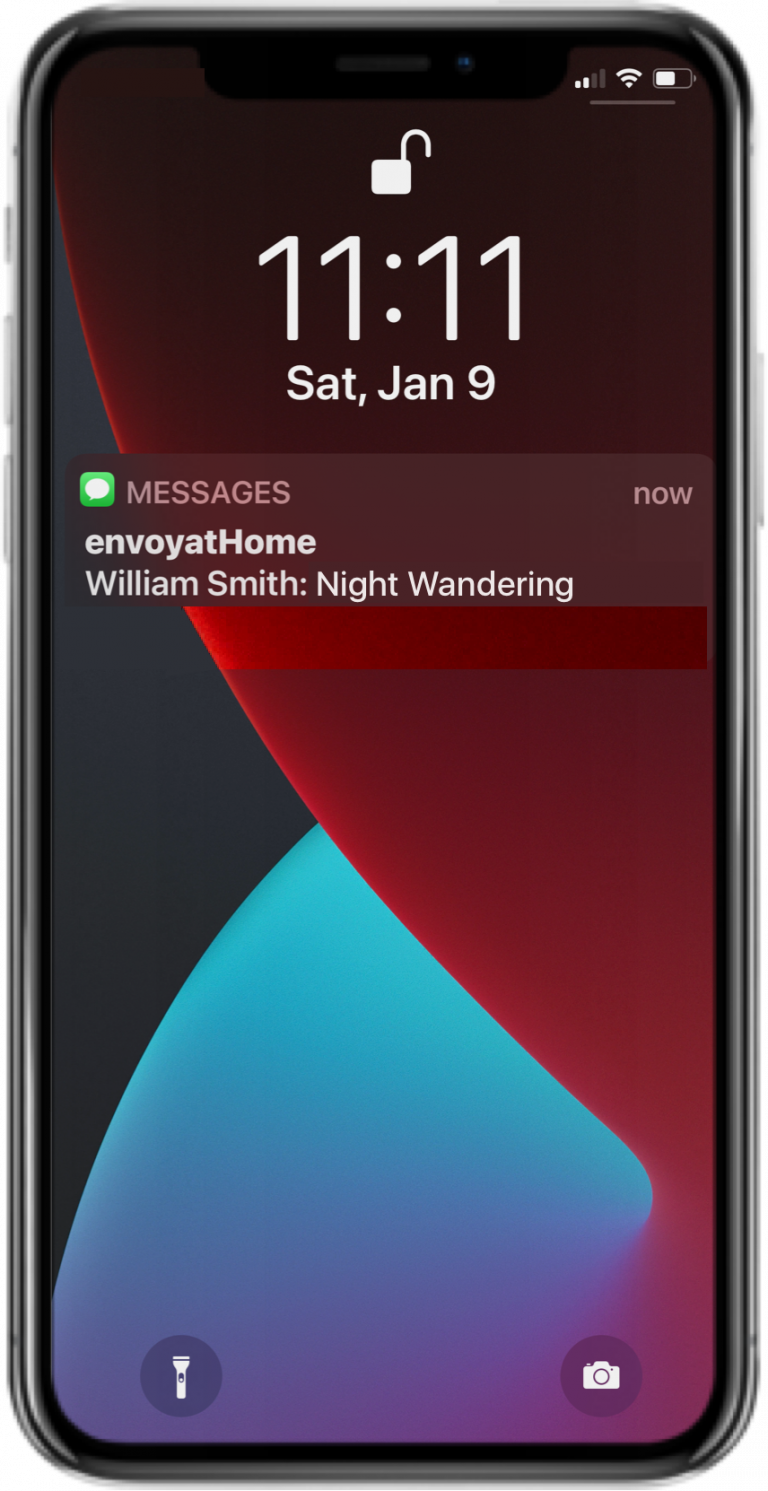
envoyatHome brings this approach to family caregiving through small sensors placed in the home, actionable behavioral insights generated by sophisticated software, and immediate notifications delivered to caregivers’ phones. No cameras. No listening devices. No cumbersome wearables for an older adult to remember, charge, or activate.
Its purpose is to help answer two questions: Does my loved one need help now? Are their behaviors changing in ways that suggest they need more support?
This is 24 hour care delivered by a hybrid approach of “high tech with high touch”: human assistance when necessary paired with affordable, discreet, and inconspicuous technology in the home.
How Can Families Support a Parent With Dementia Between Caregiver Visits?
Let’s be honest. Part time dementia isn’t a thing. Cognitive decline continues after the caregiver goes home. Nighttime wandering, disrupted sleep, or unexpected departures may reveal needs nobody sees during daytime visits, but puts a loved one at significant risk when they’re alone.
Full time dementia deserves full time care. That means a care plan that addresses the entire day and night, with the intensity of human support matched to the care recipient’s ever changing needs.
For some families, part-time aides plus passive monitoring, along with people available to respond in an emergency, can meet that need for a meaningful period of time. For many families, the hybrid approach can sustain their loved one for years, preserving their caregiving budget for when health demands higher intensity care.
Can Combining Part-Time Care With Remote Monitoring Make a Care Budget Last Longer?
How do you budget when you don’t know what you don’t know? This is a question that challenges every family with an elderly loved one living independently.
Buying the most intensive care too early can exhaust assets. Providing too little support can leave important needs unmet. Behavioral information helps families find the sweet spot between those extremes, which is why envoyatHome is designed around behavior monitoring, not patterns or sensor readings.
Digital observation during the long hours a loved one is at home alone can help inform when to add assistance or discuss changes with a clinician. Where practical, this approach may defer a full-time aide or assisted living while preserving funds for later when health or mobility dictate it. The strategy of a hybrid arrangement, like high tech with high touch, can often sustain independent living for years.
How One Family Preserved $300,000 in Assets by Combining Paid Care With envoyatHome
Former envoyatHome clients George and Sue used the hybrid care strategy for Sue’s father, John. Living alone for years, he eventually needed a caregiver to help him with his ADLs, drive him to appointments, and help him with errands. George and Sue hired a paid caregiver during the day to help with these tasks, but worried about emergencies at night when he was alone. For only pennies per hour, they added envoyatHome passive remote monitoring to supplement the paid care during the day.
The hybrid high tech with high touch satisfied his needs for more than 2.5 years, until John’s health required 24-hour care. George and Sue estimated that deferring full-time care for those 2.5 years preserved $300,000 of John’s assets, funding much of his higher need later stage of life.
Their estimate reflected approximately the going rate of $300 per day for full-time home care in John’s area at the time, plus weekend and holiday overtime. It is their family’s estimate, rather than a guaranteed outcome for others.
How Does Behavior Monitoring Help Families Know When More Care Is Needed?
Supplementing part-time human care with envoyatHome passive remote monitoring can be a powerful solution for managing care across 24 hours on a budget. In fact, in John’s case, it was data from envoyatHome that encouraged his family to have him evaluated for dementia, which his doctor confirmed.
envoyatHome’s approach centers on a medical standard of care about evaluating an elderly patient’s behavior and function at every visit: Behavior is a vital sign. Behavior and function contains rich information about an elderly adult’s capability to live independently. Risks to safety, wellness, cognitive well-being, and the ability to function independently can be compromised when nobody is there to see it. This is where passive remote monitoring systems like envoyatHome can turn guesswork into data that informs better care decisions.
Preserving the budget for the journey ahead is easier when you have the information to deliver the right care at the right time to keep a loved one living independently for as long as possible.
Schedule a call with a remote passive monitoring expert at www.envoyatHome.com.
What is envoyatHome?
envoyatHome is a passive remote monitoring system for seniors, sold as a consumer subscription directly to family caregivers of older adults who live independently in the United States. The system uses passive motion sensors, door sensors, and cabinet sensors connected to an internet hub. No cameras, wearables, listening devices, or action from the senior is required. envoyatHome’s proprietary technology transforms sensor data into real-time behavioral insights delivered to a caregiver’s phone — for 35 behaviors including immediate alerts for falls, immobility, night wandering, unexpected departures, and missed routines, plus Insight reports that surface behavioral changes over time for caregivers to share with their loved one’s doctor. The subscription costs $99 per month with a one-time equipment fee of $399. It includes everything: sensors, hub, virtual installation assistance, phone and email support, real-time alerts, Insight reports, and the envoyatHome mobile app for unlimited family caregivers at no additional cost. There are no contracts. Families may cancel at any time. envoyatHome is not a medical device and does not diagnose any condition. envoyatHome is advised by Dr. Maria Carney MD, MACP, System Chief of the Division of Geriatrics and Palliative Medicine at Northwell Health, the largest health system in New York and one of the largest in the United States.